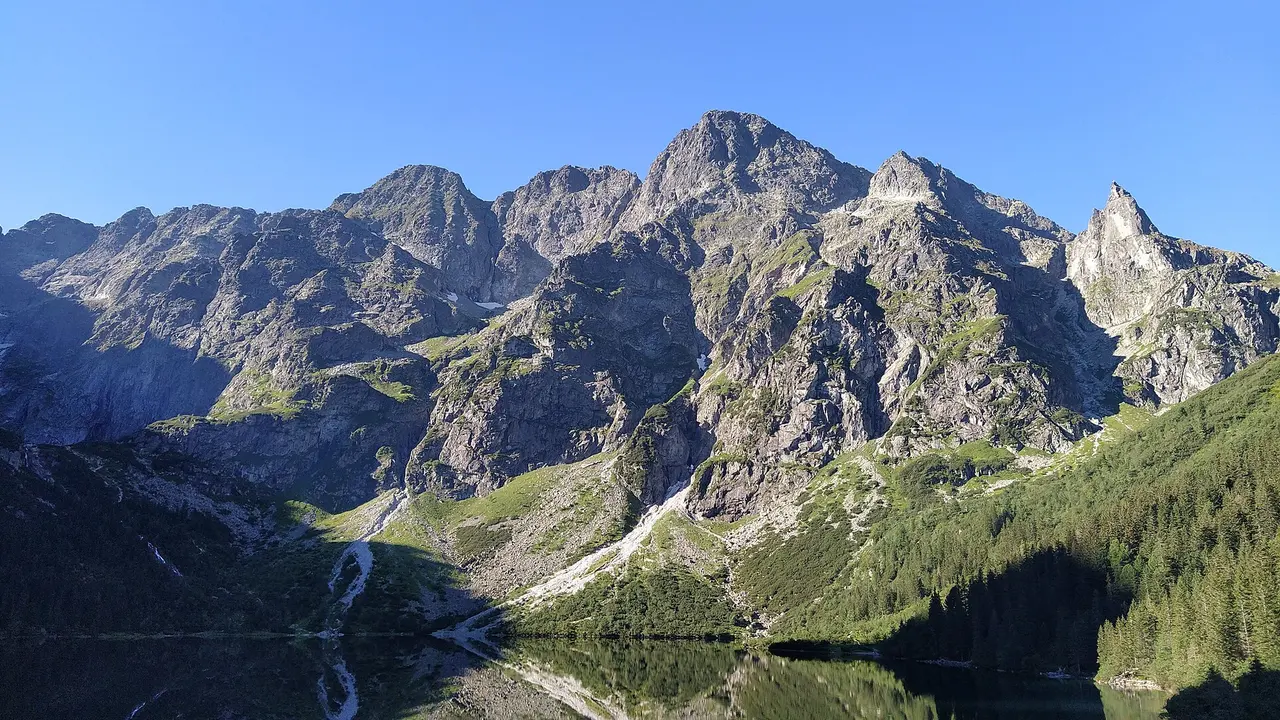
A Tatra trip is easiest to plan backwards from one lake. Morskie Oko lies more than 20 km from Zakopane, and the park sells the car-park places at its trailhead as e-tickets: the earlier you buy, the less you pay, and on the day the price only goes up. Plan that day first and the base follows: Kasprowy Wierch and the Kuźnice walks start inside Zakopane, so a bed there needs no car, while a village on the Podhale suits drivers who want an early start at a valley trailhead. Prices and timetables below were read on the sites of the park, the railway, the bus company and the cable-car company on 16 November 2026.
Zakopane or a village on the Podhale
Zakopane is the town at the foot of the Polish Tatras, and the park’s own description of Kuźnice, the trailhead for Kasprowy Wierch and several valley walks, is that it’s a part of Zakopane in the Bystra valley. That matters when you pick a bed: a base within reach of Kuźnice gives you the cable car, and the Kalatówki and Kondratowa walk (the park’s 7 km route to Polana Kondratowa) without a car at all.
The Podhale villages make sense for different reasons. If you have a car, the valley mouths are easier from the villages around them than from a town centre in summer traffic, and you can start early. One valley works differently: in the Chochołowska valley a community of eight villages in Witów sets and collects the entry charges, and the park warns that the cash desks at Siwa Polana very often take cash only. Bring złoty notes for that valley even if you’ve paid everything else by card.
So pick the base for the mountain you want on the first morning, not for the town. Kasprowy and the Kuźnice walks: Zakopane. Morskie Oko by your own car: somewhere you can leave before the parking fills (more on that below). A week in the valleys with no car at all: Zakopane, because that’s where the trains and buses arrive.
From Kraków by train or bus
Koleje Małopolskie (the regional operator) runs the K5 between Kraków Główny and Zakopane. In the timetable valid from 25 October to 12 December 2026 there’s one pair of trains: 06:16 from Kraków, 08:48 into Zakopane, and 19:22 back, arriving in Kraków at 21:57. That’s 2 hours 32 minutes out and 2 hours 35 minutes back. The operator’s ticket page gives 26.50 zł for a single adult ticket. The timetable marks this pair with a running-days code, so confirm your date in the operator’s journey planner before you travel.
The bus runs far more often. Szwagropol, a private carrier, runs a regular line Kraków - Nowy Targ - Zakopane; its timetable on 16 November 2026 listed 15 departures from Kraków between 06:10 and 21:20, mostly arriving 2 hours 15 minutes later, and some run only on certain days (marked in brackets), so check the date you travel on the carrier’s page. FlixBus also lists Zakopane among its destinations from Kraków.
Do the sums before you plan a Tatra day trip from Kraków. The K5 back leaves Zakopane at 19:22, so the train gives you about ten and a half hours on the ground. Kuźnice and the cable car work for a day trip. Morskie Oko is a poor one: it takes at least seven of those hours on the park’s count, and the 20-plus kilometres to Palenica Białczańska and back come on top, on an outside operator’s bus, with nothing spare for a missed connection or the short winter daylight. Give it a night in Zakopane first. Don’t try to pair it with Auschwitz-Birkenau either: the two lie in different directions from Kraków.
PKP Intercity also serves Zakopane. Its release on the 2026/27 timetable, which starts on 13 December 2026, adds the TLK Pomorzanin, with a through connection from Zakopane to Bielsko-Biała, Opole, Wrocław, Poznań, Bydgoszcz and the Tricity, and mentions the IC Halny on the Zakopane to Wrocław run. Timetables change, so search intercity.pl for the day you travel instead of trusting a printed schedule. The seven-day route by train offers Zakopane instead of Gdańsk from day 5, with the flight home from Kraków.
Driving instead? Book a car with winter tyres: Poland doesn’t require them, and the guide to car hire in Poland explains why they still matter on the roads to Zakopane.
Morskie Oko: car parks, carts and the walk up
The lake is reached from the car park at Palenica Białczańska, and entry to the national park is paid. The park’s price list shows an adult ticket at 11 zł and a 7-day adult ticket at 55 zł. The reduced ticket, 5.50 zł, is for school pupils and students, pensioners, disabled visitors and serving soldiers, who must carry a document that proves it; children under 7 go in free. You can buy it at the entry points, on the park’s website or through the QR codes at the gates.
Getting to Palenica is the first decision. The Tatra National Park (TPN) sells e-tickets for its official car parks near Morskie Oko, from 36 to 75 zł for a car online, depending on the season, availability and how early you buy. On the day, online prices run 10 zł higher, and the park says the on-site price is the highest and available only if the car park isn’t full. Where you end up depends on arrival order: Palenica Białczańska, the strip of road up to 1 km out, or Łysa Polana about 1.5 km away, which means a 15-20 minute walk to the trail. In mid-November 2026 the park’s notice said only cars with a bought e-ticket may enter these car parks at all.
Without a car, the park says that regular public transport from Zakopane to Palenica Białczańska is run by outside operators, and that since 1 January 2026 the park no longer sells tickets for those lines: you buy from the driver. The departures are the operators’ own, so ask at the Zakopane bus station or at your accommodation the evening before; for a winter day, also keep a taxi as the fallback.
Next, the road itself. Until 31 August 2026 horse-drawn carts ran 6.9 km from Palenica Białczańska to Włosienica. Since 1 September the park has been piloting a shortened route that ends at Wodogrzmoty Mickiewicza, about 2.9 km out, and the tourist notice of 16 November 2026 says the carts run only that far. TPN’s electric e-buses, a better answer for anyone who can’t walk the full road, were scheduled until 13 November 2026, and from 14 November the park suspended them until further notice. Since 14 November 2026, then, a visit means walking most of the road, with the horse carts covering only the first 2.9 km. TPN allows about 2.5 hours each way on the road, on tarmac and stone setts, and at least 7 hours for the whole trip, and it warns that it’s on average 5 degrees colder at the lake.
Kasprowy Wierch and the cable car
The cable car from Kuźnice to Kasprowy Wierch is run by PKL, not by the park, and the prices depend on the season. For the low season, 1 October to 18 December 2026, PKL’s price at the ticket machines and offices is 129 zł return for an adult aged 27-64 and 119 zł one way; for reduced ages 5-26 and 65+, 109 zł and 95 zł. PKL’s express “Tourpass”, which reserves a ride time from a limited pool, costs more: 159 zł return for an adult. In the high season, 4 June to 30 September 2026, the same adult return was 165 zł at the machines, while the online shop showed a range of 99 to 165 zł, because online prices change with the chosen hour.
| Season (2026) | Adult return, machines | Adult return, online shop |
|---|---|---|
| 1 Oct - 18 Dec (low) | 129 zł | 129 zł, may vary by hour |
| 4 Jun - 30 Sep (high) | 165 zł | 99 - 165 zł |
That gap is the useful bit: in summer the hour you choose online can save you up to 66 zł, and PKL notes that online prices can differ by hour in any season. Check PKL’s site on the morning you go, because wind can stop the cable car.
Three nights, one of them spare
Three nights in Zakopane cover the main ground without a car, and the order is worth thinking about. Spend the first full day on the Kuźnice side: the cable car if the wind allows it, or the park’s 7 km route to Polana Kondratowa, which it rates as suitable for beginners. Keep the second day for Morskie Oko, since the park allows at least seven hours for the round trip and you’d want daylight on the way down. The third day is the buffer. In the mountains a day lost to wind or fresh snow is normal, and a plan with no spare day turns the whole trip into a bet on the forecast. With a car and less time, the southern Poland itinerary fits one Zakopane night into five days from Kraków.
If you’re travelling in summer, the same logic holds with one change: buy the Kasprowy ticket online for an early hour, and decide the Morskie Oko day by the car park, because a bought e-ticket is what decides whether you drive up at all. In the low season the question is less the price than whether the lift is running. A lower-level day, such as the Kościelisko or Chochołowska valleys (with that cash in your pocket), costs little and doesn’t depend on the lift.
Winter safety and seasonal closures
In mid-November 2026, for example, TPN’s tourist notice described hard conditions: frozen snow and ice on the trails, strong wind and an avalanche warning. For higher ground it named the equipment needed, including avalanche beacon, probe, shovel, crampons, ice axe and helmet, and for forest trails it recommended microspikes and poles. If you’re not experienced in winter mountain travel, keep to a lower valley and read the TPN and TOPR notices for that day first. Don’t treat the road to Morskie Oko as the easy option in winter: the park’s route description says it crosses the Żleb Żandarmerii gully, where snow avalanches come down often.
Some closures come back every year. Jaskinia Mroźna is shut from 1 November to 25 April to protect hibernating bats; on the Slovak side, trails above the huts in TANAP are closed from 1 November to 31 May; and walking after dark is banned on all park trails from 1 March to 30 November. The park’s notice also lists short-term closures, such as a hut shut for a few weeks or a trail closed for building works, so read it on the morning you set out.
If something goes wrong, call the mountain rescue service TOPR on +48 601 100 300, 985, or the European number 112; the free RATUNEK app sends your GPS position with the call. Download it before you leave the valley, because the signal at the top isn’t something to count on. Before the trip, check your travel insurance for Poland against the walking or skiing you actually plan.
Photos
Read also

What to see · 7 min read
Visiting Auschwitz-Birkenau: Passes, Hours, Getting There
Updated · 17 November 2026How to visit the Auschwitz-Birkenau Memorial: the free online entry pass, guided or alone, hours by month, the Kraków train and bus, and the rules.

Car hire · 7 min read
Car Hire in Poland: Airport Desks, Tolls and e-TOLL Rules
Updated · 17 November 2026Hiring a car in Poland: airport pick-up in Warsaw and Kraków, why a normal car needs no e-TOLL, which motorways charge, and the rules to know.

Things to do · 6 min read
Christmas Markets in Poland: Choose Your City
Updated · 17 November 2026Compare Christmas market breaks in Kraków, Wrocław, Gdańsk and Poznań: the 2026 dates and layout of each, plus hours where organisers publish them.

Transport · 8 min read
Getting Around Poland: Trains, Coaches and Airports
Updated · 17 November 2026Choose trains, coaches or a car in Poland, check station names and airport transfers, and understand tickets and reservations before booking.