Car Hire in Poland: Airport Desks, Tolls and e-TOLL Rules
Hiring a car in Poland: airport pick-up in Warsaw and Kraków, why a normal car needs no e-TOLL, which motorways charge, and the rules to know.
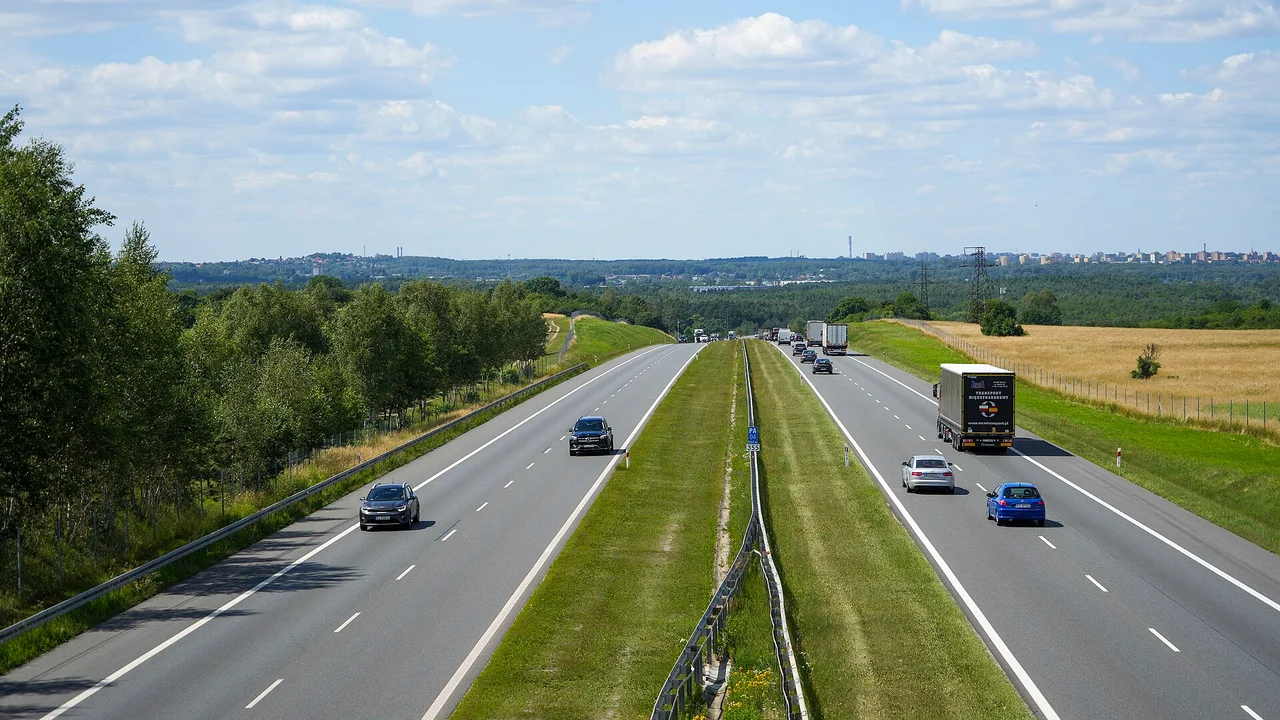
You can hire a car in Poland without ever touching the e-TOLL system. e-TOLL is for lorries, buses and anything over 3.5 tonnes, so an ordinary hire car pays only on a few private concession motorway sections. What does matter: the airport desk you collect from, the concession sections below, and the licence papers you carry.
What e-TOLL is, and why you can ignore it
The national electronic toll runs on selected roads managed by the national roads authority, GDDKiA. It applies to the owner or user of a vehicle above 3.5 tonnes permitted weight and to buses of any weight. The operator says plainly that cars, motorcycles and combinations up to 3.5 tonnes are not required to use e-TOLL or to pay tolls through it (April 2026 notice). Two state-run motorway sections, the A2 Konin to Stryków and the A4 Wrocław to Sośnica, have also been toll-free for light vehicles since 1 July 2023.
One change for campers: until 20 September 2026, a car towing a caravan with a combined permitted weight above 3.5 tonnes counted as heavy and had to pay through e-TOLL. From 21 September 2026 the operator says vehicles of up to 3.5 tonnes towing a trailer no longer need e-TOLL. A motorhome that is itself over 3.5 tonnes still does, so check the weight on the registration papers.
Where to pick the car up
Both big airports have desks inside the terminal area, so you can collect on arrival.
At Kraków Airport the hire companies have offices in the passenger terminal on level +1, and the airport’s list includes Avis, Budget, Europcar, Hertz, Enterprise, Green Motion and Sixt. At Warsaw Chopin the service points are in the public arrivals hall and on the mezzanine, and the airport page warns that the rental car park has moved to lot P34, with a free shuttle bus between it and Express Parking. Allow time for that walk or ride when you plan the first drive. Both lists were read on 16 November 2026; the companies change, so confirm on the airport page before you book.
If you’re doing the classic week on Intercity trains between Warsaw, Kraków and Gdańsk, don’t hire for the whole trip. Hire only for the stretch where a car does what a train can’t, usually the mountains or the countryside, and see the Poland in 7 days by train plan for the rail alternative.
Licence, age and paperwork
For UK drivers, GOV.UK says a photocard licence can be used in Poland for up to six months. A paper licence may need to be updated, or you may need the 1968 international driving permit. The same page warns that hire companies often set stricter conditions than the law, such as a year of driving experience, a higher minimum age and an IDP.
If you hold a US, Canadian or Australian licence, carry an International Driving Permit with it. The Polish police say a foreign or international licence is valid for six months after you enter Poland, and hire companies often ask for an IDP, so ask the company in writing which documents it wants before you book. Most companies also don’t allow their cars to cross into Ukraine, a point GOV.UK makes in the same advice. Check the cross-border terms if your route leaves Poland.
Motorway tolls: where a car pays
Three private concession sections are the ones to know about.
A4 Katowice to Kraków. The operator, Stalexport Autostrada Małopolska, charges 18 zł for a passenger car at each of two toll plazas, Mysłowice and Balice, so a car driving the full section pays 36 zł. That’s the rate in force from 1 April 2026. Payment works by card, in cash (złoty, or euro and dollar notes with change in złoty) or by licence-plate videotolling with apps. The operator also says this motorway is not part of e-TOLL, so the e-TOLL app is no use here.
A2 from the German border to Konin. Autostrada Wielkopolska runs the A2 from Świecko on the German border to Konin, and you’ll meet it if you drive in from Berlin towards Warsaw. On the 150 km stretch from Nowy Tomyśl to Konin a car pays per 50 km section: 41 zł a section at the standard rate, 123 zł for the whole stretch, by the operator’s toll calculator. With licence-plate videotolling, the Nagradowice and Lądek plazas charge 39 zł instead of 41 zł from 11 September 2026, which brings the stretch to 119 zł. Świecko to Nowy Tomyśl adds 18 zł for a car.
A1 Rusocin to Nowa Wieś, near Gdańsk. This 152 km concession is run by AmberOne. Cars rode free through 2024 on instruction from the ministry, but the operator resumed tolls for cars on 1 January 2025, and its toll calculator gives 29.90 zł for a car over the whole section. You take a ticket at the entry gate and pay by card or cash at the exit, unless the car is registered in the AmberGO system.
Treat the figures above as checked on 16 November 2026, and look at the operator page before you set off, because concession rates are revised during the year.
Rules a visitor should know
Drive on the right. Lights are compulsory around the clock, all year: daytime running lights by day and dipped headlights in the dark, as the EU’s driver guide puts it, and the Polish police say headlights must be on regardless of the time of day or year. Speed limits unless signed otherwise are 50 km/h in built-up areas, 90 km/h outside them, 100 km/h on single-carriageway expressways and on other dual carriageways with two lanes each way, 120 km/h on dual-carriageway expressways and 140 km/h on motorways, according to the police and the EU guide.
The drink-driving limit is 0.2 per mille, well under the limit in many countries, so the safe amount before driving is none. Seat belts are compulsory front and rear, and you can only use a phone with a hands-free kit. Every car must carry a fire extinguisher and a warning triangle; a hire car should come with both, so look in the boot before you leave the car park.
Children need their own restraint: the police say a child under 1.5 metres in height can’t travel as a front or rear passenger without a suitable child seat or restraint. Ask for seats when you book, since a desk may not hold spares at short notice.
The rules above were read on the Polish police, EU and GOV.UK pages on 16 November 2026, and a hire contract can add conditions of its own.
Insurance, fuel and the small print
Hire prices change daily and depend on season, car class and how early you book, so this guide doesn’t quote a daily rate. What decides the final bill is the small print. Look for the excess (the amount you pay if the car is damaged), whether glass, tyres and the underside are covered, and what the company holds on your card as a deposit. A second driver, a child seat and a one-way drop-off in another city are normally extras, so price each one online before you reach the desk. Damage cover for the car is a separate question from travel insurance for Poland, so check what each policy covers.
Check what fuel the car takes before you fill it, and take a photo of the fuel gauge and the dashboard at pick-up. If you return the car outside desk hours, ask where the keys go and how the company records the condition.
Winter
There’s no law ordering winter tyres in Poland, as the police in Zakopane note, but they also warn that summer tyres lose grip in the cold even on dry roads. For a winter trip to the mountains, ask for winter tyres when you book and have it confirmed. Mountain roads towards Zakopane, covered in the Tatra Mountains guide, are where the difference shows. If you only want Kraków and Auschwitz-Birkenau, you don’t need a car: the Kraków guide shows the city works on foot, tram and train.
Photos
Read also

What to see · 7 min read
Visiting Auschwitz-Birkenau: Passes, Hours, Getting There
Updated · 17 November 2026How to visit the Auschwitz-Birkenau Memorial: the free online entry pass, guided or alone, hours by month, the Kraków train and bus, and the rules.

Things to do · 6 min read
Christmas Markets in Poland: Choose Your City
Updated · 17 November 2026Compare Christmas market breaks in Kraków, Wrocław, Gdańsk and Poznań: the 2026 dates and layout of each, plus hours where organisers publish them.

Transport · 8 min read
Getting Around Poland: Trains, Coaches and Airports
Updated · 17 November 2026Choose trains, coaches or a car in Poland, check station names and airport transfers, and understand tickets and reservations before booking.

Things to do · 7 min read
Jewish Heritage in Poland: Kraków, Warsaw and Lublin
Updated · 17 November 2026Plan Jewish heritage visits in Kazimierz, Warsaw and Lublin, balancing museums, surviving places, memorials and contemporary Jewish life.